When speaking with researchers about lab equipment, it is not uncommon to hear “I wanted a rocker and I got a shaker,” or even the reverse, “I wanted a shaker, and I got a rocker!”
It is common for all of the terms to be confused. They seem to vary by region, such as those who refer to a carbonated cola beverage as “pop” or “soda.” Manufacturers also use the terms somewhat interchangeably.
Below, we’ve included a few simple diagrams to help explain the difference between these products, along with a list of questions to help you find the best equipment for your scientific research needs.
Rocker
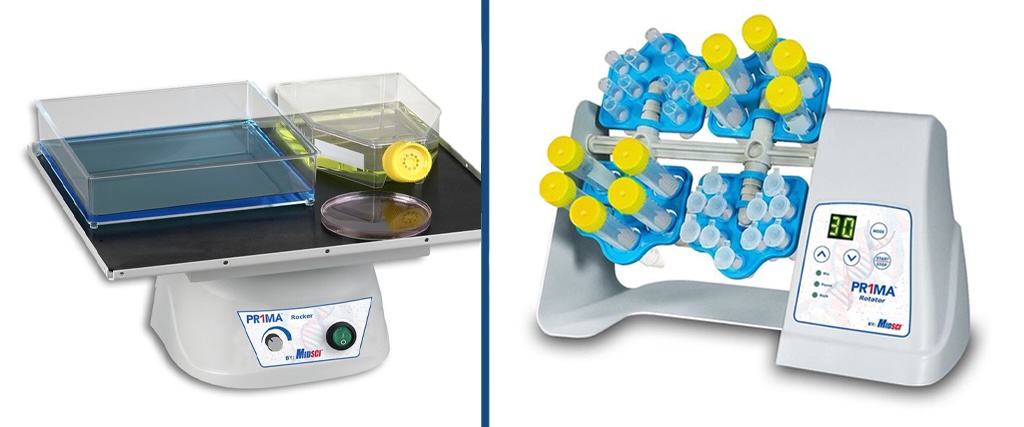
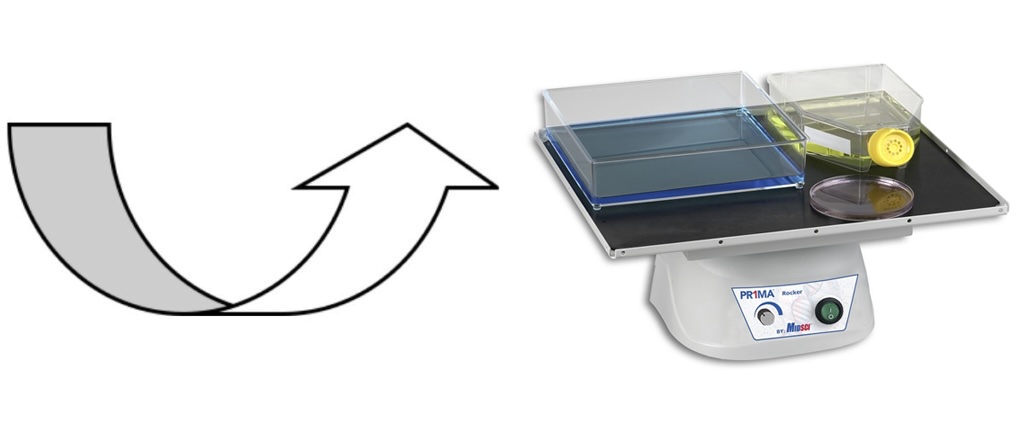
A rocker, like the MIDSCI product pictured below, moves back and forth like a rocking chair. This model can be used for a broad range of mixing applications.
Rather than rapidly shaking samples, laboratory rockers use a controlled, gentle rocking motion to keep liquids moving. This makes them especially useful for delicate applications where vigorous mixing could potentially damage samples or create unwanted foaming. Common applications include gel staining and destaining, Western blotting, washing, hybridization, and other procedures that benefit from consistent, gentle agitation.
Depending on the type of rocker, the platform may produce a simple back-and-forth motion or a more complex tilting motion that creates continuous movement throughout the sample.
Types of Laboratory Rockers
Although laboratory rockers share the same basic purpose, the way the platform moves can differ. Two of the most common options are 2D and 3D rockers.
- 2D Rockers: A 2D rocker, sometimes called a platform rocker or see-saw rocker, uses a side-to-side motion in a single plane. The platform alternately raises and lowers at each end, creating the familiar back-and-forth motion of a rocking chair. This gentle rocking motion works well for applications that require consistent agitation without aggressive mixing. The predictable movement makes 2D rockers a common choice for gel staining and destaining, Western blots, washes, and other delicate applications.
- 3D Rockers: Rather than moving along a single axis, a 3D rocker uses a nutating motion that combines tilting in multiple directions. Sometimes referred to as a nutating rocker, this design creates a smooth, wave-like motion across the platform. The 3D movement allows liquids to circulate throughout the vessel while maintaining relatively gentle agitation. Depending on the application and vessel being used, this can provide more thorough mixing across the sample than a traditional side-to-side rocker.
Pictured Below: MIDSCI Variable Speed 2D Rocker, Shop PR1MA™ Rocker
Shakers
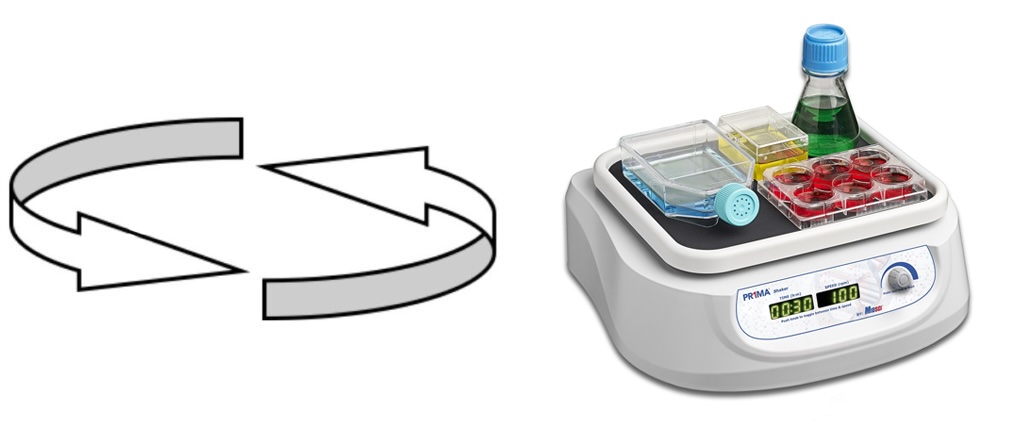
Moving in a horizontal circular motion, shakers are designed for thorough mixing of any vessel. This continuous movement helps keep samples and solutions in motion without requiring manual agitation, making laboratory shakers useful for everything from routine mixing to longer protocols that require consistent movement over time.
Shakers are available in a wide variety of configurations, speeds, and platform sizes. Some are designed to hold flasks, bottles, or tubes, while others are made specifically for microplates. Depending on the application, researchers may also encounter equipment described as a platform shaker, linear shaker, reciprocal shaker, rotary shaker, rocking shaker, wrist action shaker, or combination shaker. Because these terms can sometimes overlap between manufacturers, paying attention to the actual mixing motion and specifications is important when selecting a unit.
Types of Laboratory Shakers
The right laboratory shaker depends on what you’re mixing, the vessels you’re using, and the speed and motion required by your protocol. Some common options include:
- Digital Shakers: Digital shakers provide precise control over operating parameters such as speed and run time. Depending on the model, a digital shaker may use an orbital, linear, or other mixing motion. Digital controls can be particularly helpful when protocols need to be repeated under consistent conditions.
- Orbital Shakers: An orbital shaker moves samples continuously in a circular orbit on a horizontal plane. These units are commonly designed as platform shakers that can accommodate flasks, bottles, racks, and other vessels, with clamps or accessories used to keep containers secure. Orbital shakers are useful for a wide variety of mixing applications where consistent, thorough agitation is needed.
- Plate Shakers: Plate shakers are designed specifically for mixing samples in microplates. Their compact platforms and controlled shaking motion make them useful for applications involving 96-well and other plate formats, particularly when many small-volume samples need to be mixed at the same time.
Other specialized options are available for workflows that require different types of movement. A reciprocal shaker, for example, uses a linear back-and-forth motion rather than the circular movement of an orbital shaker, while wrist action shakers create an action similar to hand shaking. Combination equipment can provide multiple types of motion, and double-stage shakers can increase platform capacity when a laboratory needs to process more vessels without substantially increasing the equipment’s footprint.
Pictured Below: MIDSCI Orbital Shaker, Shop Orbital Shaker
Rotators
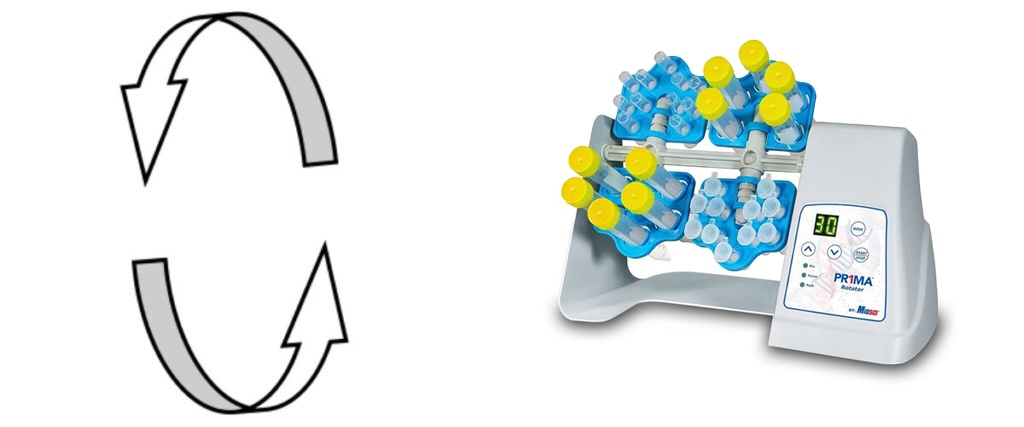
The most distinguishing feature of a rotator is its end-over-end motion, which may be vertical mixing, horizontal mixing, or both. Rather than placing vessels on a flat platform, many laboratory rotators hold sample tubes in racks or holders and continuously turn them to keep their contents moving.
This tumbling action provides consistent, gentle mixing and can be especially useful when samples need to remain suspended without the more vigorous agitation of a shaker. Depending on the model and configuration, rotators can accommodate a variety of sample tubes, including centrifuge tubes, and may offer adjustable angles, interchangeable tube holders, or variable speeds to accommodate different applications.
Types of Laboratory Rotators
Rotators are available in several configurations based on the type of vessel being mixed and the motion required. Common options include:
- Tube Rotators: A tube rotator holds individual sample tubes and rotates them continuously, often using an end-over-end tumbling motion. A variable speed tube rotator gives researchers greater control over the intensity of mixing and can accommodate different protocols, tube sizes, and sample types.
- Rotisserie Rotators: A rotisserie rotator holds tubes in a wheel or disk-like configuration and turns them end over end, similar to the motion of a rotisserie. Some models allow the tube holders to be repositioned or exchanged, providing a customized configuration for different vessel sizes and mixing requirements.
- Tube Rollers: Instead of turning tubes end over end, a tube roller places vessels horizontally across rotating rollers. The resulting rolling and gentle rocking action continuously moves the liquid inside, making tube rollers useful when consistent horizontal mixing is preferred.
Some laboratory rotators also allow researchers to change the orientation of the tubes to produce vertical mixing, horizontal mixing, or a combination of movements. When comparing a tube revolver rotator, rotisserie shaker, tube roller, or other rotating mixer, consider the required motion along with the size and number of tubes you need to accommodate.
Pictured Below: MIDSCI Roto-Mini Series, Shop Roto-Mini Series
3-D Models
You may also hear these products referred to as Belly Dancers™, Nutating Mixers, or Gyro Twisters. These provide a unique undulating motion that some scientists prefer to a rocker or shaker.
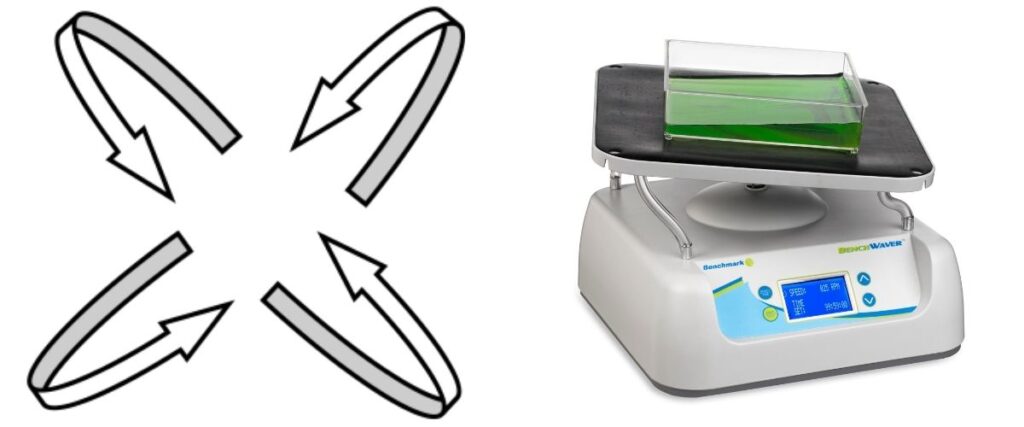
Rather than moving strictly from side to side or in a horizontal circular pattern, 3-D mixers tilt the platform in multiple directions at the same time. This creates a gentle, wave-like motion that continuously circulates liquid throughout the vessel. The combination of rocking and rotating movement can provide thorough mixing without the more aggressive agitation produced by some laboratory shakers.
Because of this gentle nutating motion, 3-D models can be useful for applications where samples need continuous movement while minimizing foaming or excessive agitation. Depending on the model, applications may include gel staining and destaining, Western blotting, washing membranes, hybridization, and other protocols involving delicate samples.
Types of 3-D Laboratory Mixers
Although terminology varies between manufacturers, you may encounter several names and configurations when looking for 3-D mixing equipment:
- 3-D Rockers: A 3-D rocker tilts in multiple directions rather than using the simple back-and-forth motion of a traditional 2D rocker. This produces a smooth, wave-like movement across the platform for gentle, continuous mixing.
- Nutating Mixers: A nutating mixer combines rocking and rotating motions to create an undulating pattern. This type of movement helps circulate liquid throughout a vessel and can be useful for applications requiring gentle but thorough mixing.
- Gyro Twisters: Gyro Twister is another term you may encounter for equipment that produces multi-directional mixing. Rather than shaking samples aggressively, these mixers use a controlled tilting and rotating motion across the platform.
The distinction between these products is not always clear-cut, since manufacturers may use terms such as 3-D rocker, nutating mixer, or 3-D rotator differently. As with shakers, rockers, and rotators, focus on the actual motion, speed range, platform capacity, and application requirements when determining which 3-D model is right for your lab.
Pictured Below: Benchmark BenchWaver 3-D Rocker, Shop BenchWaver 3-D Rocker
5 Questions to Help Assess Your Mixing Equipment Needs
Once you know which mixing product you are looking for, it is much easier to get what you want AND need. Use these five questions as a guide during the purchasing process:
- “Will I need materials to be heated or cooled?”
There are a wide variety of units that come with heating and refrigeration capabilities. For temperature-sensitive samples, options such as incubator shakers, thermal mixers, and shaking water baths combine controlled temperatures with consistent mixing. Consider the required temperature range, mixing motion, variable speed capabilities, and operating environment when choosing the right unit. - “How big of a platform do I need?”
Choose from products with single and stacking platforms or a variety of platform sizes. Before ordering, it is helpful to lay out the maximum supply of materials you would shake at one time and measure the occupied space. This can help ensure you don’t order a platform that is too small or one that takes up half the bench to rock one Western blot. Many units also have holders, clamps and/or racks for a variety of vessels. - “What is my max RPM?”
RPM stands for rotations per minute. Not sure if you need capability for 60 RPM or 300 RPM? Think of tracing the outside of a dinner plate with your finger. A unit with 60 RPM moves at a speed comparable to tracing the outside of the plate in one second, or 60 rotations in one minute. At 300 RPM, the speed is comparable to completing five rotations around the dinner plate in one second. - “Will I need the unit to be compatible in any environment other than normal bench life?”
Be careful moving your equipment into different environments. A CO2 incubator will destroy a normal bench shaker. Instead, look for something that is meant to be put in a CO2 incubator. Cold rooms and general incubators can also shorten the unit’s life unless it can acclimate. And with some units, you will void the warranty if it’s used anywhere besides the bench. If the unit is to be used in a unique environment, read the specs or ask your supplier. - “What works best for the applications I will be performing?”
After speed and temperature, your protocol will help determine the product best-suited for the job. For example, if you are doing Western Blots, many labs will argue a rocker is better than a shaker or a shaker is better than a rocker.
MIDSCI Can Help You Shake, Rattle and Roll with the Right Motion Equipment
Save time and frustration by ordering your laboratory equipment with MIDSCI. We are large enough to deliver and small enough to care, for a wide range of equipment that controls motion and temperature. We help scientific researchers find the best equipment, including shakers, stirrers, rockers, rotators, and much more. And we’ve got the customer service team you need to feel confident in your purchase.
A MIDSCI lab consultant is here to help anytime! Or Call 800.227.9997