When choosing between an analog and digital balance for your laboratory, a digital balance will generally be the better choice when accuracy, readability, repeatability, and advanced weighing functions are priorities. Analog balances still have advantages, particularly for straightforward weighing applications where simplicity, durability, and independence from a power source may be valuable.
However, the decision is not always as simple as digital versus analog. Your required capacity, readability, calibration needs, applications, and laboratory environment should all play a role in determining the right balance.
How Do Analog and Digital Laboratory Balances Work?
Analog balances measure mass mechanically. A traditional mechanical balance may use beams, sliding weights, springs, or other physical components to determine the mass of a sample. The researcher reads the measurement from a scale rather than an electronic display.
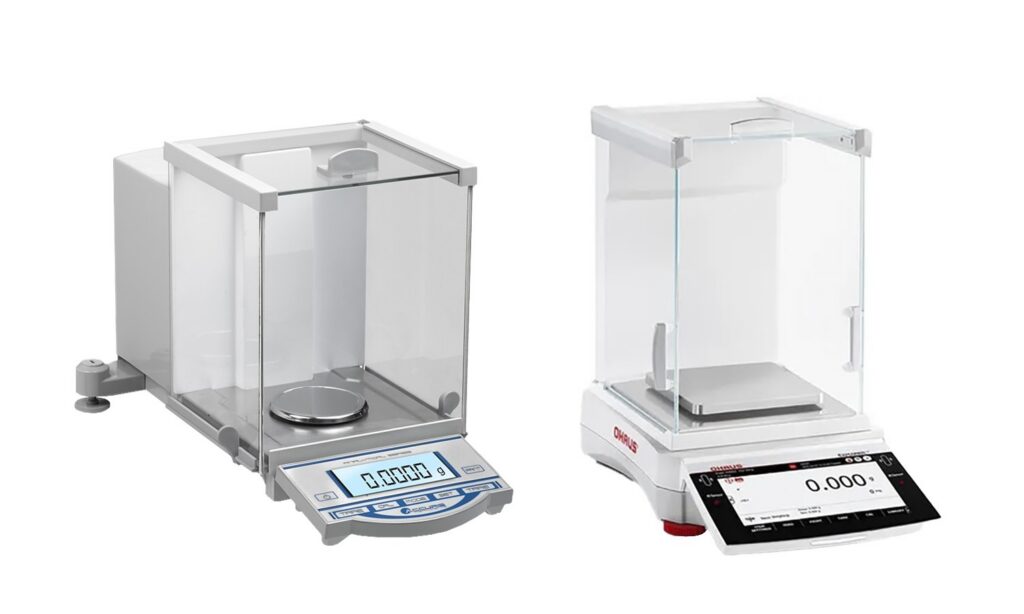
Digital laboratory balances use electronic weighing technology to detect the mass placed on the weighing pan and display the result on a screen. Depending on the model, these instruments may incorporate sophisticated sensors and software to provide fast, highly precise measurements.
Digital balances also eliminate the need for the user to interpret the position of a pointer or manually adjust weights, making results easier to read and record.
Analog vs. Digital Balance Accuracy and Precision
For most modern laboratory applications where precise measurements are critical, digital balances have a significant advantage.
With an analog balance, the smallest measurement you can reliably determine is limited by the graduations on the scale and the researcher’s ability to read them. Viewing angle and interpretation can also introduce variability.
Digital balances provide a numerical measurement directly on the display, reducing the possibility of reading errors. More importantly, today’s laboratory balances are available with extremely fine readability.
MIDSCI offers several types of digital balances depending on the level of accuracy required:
- Analytical balances are intended for high-accuracy measurements and demanding weighing applications.
- Precision balances balance accuracy with the capacity and durability required for everyday laboratory weighing.
- Top-loading balances offer convenient, efficient weighing for general workflows and sample preparation.
For example, some analytical balances available from MIDSCI provide readability down to 0.0001 g, while certain semi-micro configurations offer even finer readability. Choosing the appropriate level of precision is important because not every laboratory application requires the most sensitive balance available.
Digital Balances Offer More Than a Digital Display
One of the biggest differences between analog and digital laboratory balances is the number of functions that can be built into a digital instrument.
Depending on the model, digital balances may offer features such as:
- Automatic or internal calibration
- External calibration capabilities
- Tare functions
- Multiple weighing units
- Piece counting
- Percent weighing
- Check weighing
- Touchscreen or backlit LCD displays
- Data output to computers or printers
- USB, RS232, Ethernet, or other connectivity options
These capabilities can make a digital balance particularly useful in laboratories that need to document results or repeat weighing procedures efficiently.
More advanced models can also help integrate weighing into a laboratory’s digital workflow. If your lab has GLP/GMP documentation requirements or needs to transfer results between instruments and computer systems, connectivity and data-management features may be just as important as the balance’s basic weighing specifications.
Comparing Durability and Maintenance
The relative simplicity of an analog balance can be an advantage when it comes to durability. Mechanical balances have fewer electronic components, and some can operate without electricity or batteries. That can make them useful for basic classroom, field, or routine weighing applications.
Digital laboratory balances require more attention to their operating conditions. Highly sensitive models can be affected by vibration, drafts, static electricity, temperature fluctuations, or an improperly leveled work surface.
However, modern digital balances are also designed with laboratory use in mind. Depending on the model, features such as stainless steel weighing pans, chemical-resistant components, draft shields, leveling indicators, and protective covers can help provide dependable long-term performance.
Regardless of which type you use, routine cleaning, proper handling, and regular calibration are important for maintaining reliable measurements.
Pros and Cons of Analog Laboratory Balances
Analog balances continue to have a place in laboratories where straightforward weighing is all that’s required.
Advantages can include:
- Simple operation
- No need for electricity on fully mechanical models
- Durable construction
- Useful for basic demonstrations and routine measurements
- Potentially lower initial cost
The tradeoff is that analog balances generally cannot match the readability, convenience, or advanced capabilities of modern digital laboratory balances. They also require the researcher to read the measurement manually, potentially introducing additional variability.
Pros and Cons of Digital Laboratory Balances
For research, pharmaceutical, industrial, and other laboratories where reliable measurements are important, digital balances provide several advantages.
These include:
- Greater readability and precision
- Fast, easy-to-read results
- Reduced potential for reading errors
- Convenient tare and calibration functions
- Multiple weighing modes
- Data connectivity on compatible models
- Options ranging from compact balances to high-accuracy analytical balances
Digital balances generally cost more than simple mechanical models, particularly as accuracy and advanced features increase. They also require power and may need greater protection from environmental factors.
For many laboratories, however, the improved performance and additional functionality provide greater value over the life of the instrument.
Consider More Than the Initial Cost
Cost matters when purchasing any laboratory instrument, but the least expensive balance is not necessarily the best value.
Before comparing prices, determine what your laboratory actually requires. Purchasing a highly sensitive analytical balance for basic weighing could mean paying for precision you don’t need. On the other hand, choosing an inexpensive balance that cannot provide the required readability could compromise your workflow and eventually require you to purchase another instrument.
Consider factors such as:
- Maximum weighing capacity
- Required readability
- Repeatability
- Calibration requirements
- Frequency of use
- Data and documentation requirements
- Available bench space
- Laboratory environment
- Expected lifespan
Finding the right balance between these factors can help you invest in an instrument that supports your work without paying for unnecessary capabilities.
Which Balance Is Best for Your Laboratory?
Start with what you need to weigh and how accurately you need to weigh it.
If you need a simple instrument for demonstrations or basic measurements, an analog balance may be sufficient. For most research laboratories requiring precise, repeatable measurements, a digital balance is likely the more practical choice.
From there, determine which type of digital laboratory balance fits the application.
A top-loading balance can be a good fit for routine sample preparation and applications that prioritize capacity and speed. Precision balances provide greater readability for applications requiring more exact measurements. For highly sensitive analytical work, an analytical balance provides the fine readability and controlled weighing environment needed for very small differences in mass.
The best balance isn’t automatically the one with the highest level of precision. It’s the one that provides the appropriate capacity, readability, repeatability, and functionality for the work your laboratory performs.
Find the Right Laboratory Balance at MIDSCI
From everyday weighing to high-accuracy analytical work, MIDSCI offers digital laboratory balances designed for a wide range of research, quality control, pharmaceutical, industrial, and educational applications. Explore analytical balances, precision balances, and top-loading balances from trusted manufacturers, or connect with a MIDSCI lab consultant for help determining which specifications and features make sense for your laboratory setup.
Shop MIDSCI Laboratory Balances
A MIDSCI lab consultant is here to help anytime! Or Call 800.227.9997